Articles

Biking in a Winter Wonderland

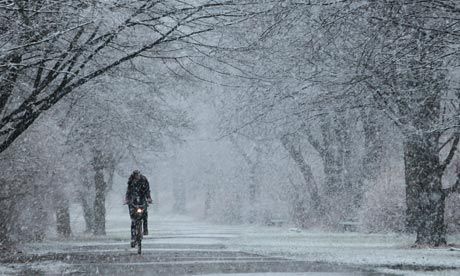
The days are shorter, the temperatures are colder, and one's concentration goes to the holidays.  For many, this means that it is time to hang the bike up on the wall - to be taken out next spring.  But...there are those among us who not only ride all winter, but actually enjoy it.  There is something very satisfying about going outside and conquering the elements. Here is a guide for those who are curious about how to do a winter ride.

WHAT TO WEAR:     In a word - layers.  Layers help trap the air that serves as insulation.  They also help regulate body temperature as you can put on and take off layers as your body temperature heats up or cools down while you ride.  Last year, Nathali Pham, Bobby Moleti and I had a 40 mile ride on the coldest day of the year.  The thermometer was reading 0, and the wind gusts were over 40 MPH.  Here is what I wore from bottom to top.  

Hands and Feet - If your extremities ain't happy, you ain't happy.  I wore silk liner socks, heavy woolen socks and insulated hiking boots.  Eschewed clipping in for warmth.  Other cyclists like using toe caps or neoprene covers for your feet.   On my hands I wore a pair of liner gloves and winter cycling [semi lobster] gloves.  Cyclists have also been known to use chemical hand and foot warmers.

Below the Waist - A pair of silk long underwear.  A pair of thermals.  A pair of wind resistant sweat pants.  

Above the Waist - Silk liner, heavy jersey, polar fleece, Columbia wind resistant jacket.

Neck and Head - Neck Gaiter [my favorite piece of winter wear, as it can be pulled up for extra coverage of the ears], balaclava and/or cap with ear flaps, helmet cover.

ON THE RIDE:     Another great winter investment is a Thermos.  Having a hot beverage during the ride helps to warm up the core.  I normally have something non-alcoholic, as alcohol actually thins the blood and can make you colder.  [Of course, sometimes I break this rule].  When I feel the chill, a hot cup of herbal tea, coffee, mocha or my favorite - hot apple cider always helps.  I put warm water in my water bottle and hope that it does not freeze.   Water is just as important during a winter ride as you still will sweat owing to the exertion and the layers.  Make sure that you continue to drink water, as dehydration can occur on winter rides as well.

A nice hearty lunch stop is also a great way to warm up.  On the zero degree day, we stopped at a Korean BBQ place.  Other wonderful places to stop at are Russian restaurants like Cafe Glechic for some hot borscht, pho in Vietnamese places, rib sticking Polish food.  One of the monster burgers at the Bay House in Hook Creek was another popular winter ride lunch stop.

Whether on a club ride compression stop, or just riding with friends, seek the sun.  The direct rays of the sun will warm even through the winter.

After the ride, make sure to take care of your bike.  Salt on the road can have nasty effects on the chain, derailleurs and frame.  Make sure to clean and lube the chain and clean the frame on a regular basis.  I stick with Tri Flow - but there are others who swear by wet lube in the winter.  

Take your Metrocard.  Sometimes stuff happens.  Take the train and live to ride another day.

WHEN NOT TO RIDE:   When road conditions are not safe, do not ride.  Riding on icy road conditions is flat out dangerous.  Not only is it more difficult to control your bike, but it is also more difficult for motorists to control their cars.  Unless you are Brian Hoo with his Fatty Bike, best wait till it thaws.

Know your body.  I am fine with really cold temperatures.  Must be the Russian blood that courses through my veins.  But YOUR body may not feel that way.  If you are asthmatic, how does the cold weather effect your breathing?   If you have any circulation issues, how does that effect your body?  Arthritis?   The above tips will make it easier - but if you are in discomfort or pain, it's just not worth it.  Head to the gym and take a spin class.

IN CONCLUSION:    There is no need to hibernate during the winter.  Dress warm.  Gear up.  And ride.   The 5BBC has rides that will be [hopefully] going out throughout the winter season.  Make sure to check the web site and FB page as winter rides do get canceled more often than summer ones.  For many winter warriors, these are some of the best rides of the year.  We have smaller and more cohesive groups, we warm up at a great lunch stop, and we laugh at the cold.  Sooner or later, the weather will break, and the Spring Training Series will be upon us.  Every mile that you do this winter, is a mile easier in the spring.  

See you [bundled up] on the road.


A Few Favorite Bicycling Charities

5BBC put out a call to our members to nominate charities that serve a local or national constituency and focus on bicycling or bicycling-related issues. Here's who our members recommended.


Achilles International
www.achillesinternational.org

501(c)(3) charity

Through a local New York chapter, they help New Yorkers with disabilities gain independence and personal achievements through running and cycling.


Bike New York
www.bike.nyc

501(c)(3) charity

Teaches many people to ride a bike. Feeds the club people, offers our members volunteer opportunities.


Biketothebeach
Biketothebeach.org

501(c)(3) charity

Bike to the Beach promotes cycling for fun and fitness while seeking to raise money and awareness for autism through charity rides from urban areas to nearby beaches. A 5bbc sponsor they are planning to sponsor again in 2017 and make a donation too.... this would be a nice gesture as they plan to encourage more than 300 and growing ridership to join 5bbc and partake in our spring training series to prep for their ride Manhattan to west Hampton in June.


Bronx River Alliance
www.bronxriver.org

501(c)(3) charity

The Bronx River Alliance supports a clean river (environment) and cycling. What more can you ask for? They had great events geared towards cyclists last year. Plus the Bronx needs it.


Brooklyn Greenway Initiative (BGI)
www.brooklyngreenway.org

501(c)(3) charity

This organization has designed a 14-mile landscaped cycling greenway along the Brooklyn Waterfront from Greenpoint to Bay Ridge to encourage cycling by connecting neighborhoods and parks. They always need funding to complete this vision.


East Coast Greenway Alliance
www.greenway.org

501(c)(3) charity

The East Coast Greenway Alliance is promoting the establishment, stewardship, and public enjoyment of a traffic-free multi-user trail linking cities and towns from Maine to Florida.


I Challenge Myself
www.ichallengemyself.org

501(c)(3) charity

I Challenge Myself helps public high school students in Manhattan and the Bronx strengthen their bodies, minds and spirits through non-competitive cycling programs, including a "Cycling Smarts" PE class on the streets of the five boroughs, a youth-only century ride, and an annual College Bike Tour of seven state colleges.


New York Bicycling Coalition
www.nybc.net

501(c)(3) charity

New York Bicycling Coalition advocates for pro-bicycle policies and funding at all levels of government; educates New Yorkers about bicycle safety and the benefits of bicycling; provides technical assistance and support to advocates and government entities; and promotes bicycle tourism across the state.


Recycle a Bicycle
www.recycleabicycle.org

501(c)(3) charity

Recycle a Bicycle gives youth job skills in addition to keeping bikes out of landfills and making them ridable. It is very difficult for young people to learn marketable skills. Even those who have gone through the program but continued to work as bike mechanics, still develop useful skills. Involvement with an organization and program like RAB can motivate a young person to stay in school or to continue on to higher education.

They provide free bikes to children. (Need I say more?) Also, free job training, environmental education, High School Internships, Summer Youth Employment Program, and Kids Ride Club. On average, RAB salvages 1,800 bicycles each year from the waste stream. There is almost nothing about this organization that is not perfect and worth our help.


Riders Alliance
www.ridersny.org

Donations are tax deductible through partnership with Fund for City of New York

Riders Alliance is trying to improve public transportation. Public transportation includes bike racks on buses and better bike accessibility for all. I think it's a worthy cause.


Streetsblog NYC
streetsblog.org

a project of OpenPlans, a 501(c)(3) organization

a project of OpenPlans, a 501©(3) organization Streetsblog is a daily news source connecting people to information about sustainable transportation and livable communities. Streetsblog NYC provides vital coverage of the issues and current news items of concern to cyclists and is an important voice for safety.


Transportation Alternatives
www.transalt.org

501(c)(3) charity

Why? Dude. Are you serious?

This organization is doing more for cycling in NYC than any other.

Advocates for bikers and pedestrians.

They help keep the streets safe for cyclist.

Look around New York. Transportation Alternatives has worked relentlessly to get bicycle lanes throughout the city. Protected lanes on Columbus, Amsterdam, and downtown did not happen on their own. Long hard activist endeavor brought them about. We need more. Supporting TA will make for a safer cycling environment.

Transalt has been the driving force behind activism on behalf of bicycle riders and pedestrians in NYC. Members of the community are able to join and participate on a grass roots level. Their work is giving a voice to New Yorkers concerned about safe streets. The support for Families for Safe Streets has made those affected by street violence visible to politicians and policy makers in both NYC and at the state level.

TA has the political clout to effect significant change on our streets, and an end-of-year contribution will be doubled if there is a matching donation in effect.

Many 5BBC donate time to this organization. The Bronx Committee is running a toy drive this holiday season for a local homeless shelter on the Grand Concourse in the Bronx. 


Our Annual Non-Perishable Food Drive

5BBC members, family, & friends.


Once again, in the spirit of the holidays, it would be much appreciated if you can bring one or a few non-perishable food items to the Christmas party on December. 3rd.   These items will be distributed to selected seniors through out the Harlem Community.  Thank you in advance for any contribution that you can make.


Ken Williams


Cliff Kids Zone Coming to the Supercross Cup on November 19-20

NEWS RELEASE

FOR IMMEDIATE RELEASE

CONTACT: Marc Bertucco, marcbertucco@yahoo.com

SOCIAL MEDIA: Facebook: www.facebook.com/Supercross.cup.weekend
Twitter: @Supercrosscup
Web: www.supercrosscup.com

WORLD-CLASS PROFESSIONAL BICYCLE RACERS
TO COMPETE ON THE CAMPUS OF
ROCKLAND COMMUNITY COLLEGE

Suffern, NY, October19, 2016—Celebrating its fourth year in Rockland County, the
Supercross Cup joins the Vittoria Northeast Cyclocross Series, the country’s only internationally-ranked professional cyclocross series. With valuable series points and money in play for amateurs and pros alike, Supercross is expected see over 1000 racers and spectators land on the athletic fields of The Rockland Hawks on Saturday and Sunday, the weekend of November 19th and 20th.

WITH BEGINNERS OF ALL AGES AS WELL AS SEASONED PROS,
CYCLOCROSS IS THE FASTEST GROWING SEGMENT OF BIKE RACING TODAY. IT’S NO WONDER: THIS IS EXCITING “TOUGH-MUDDER”-STYLE ADVENTURE RACING…WITH BIKES!

Click here for a 8-minute highlight video from last year’s Pro men’s event:

http://dirtwire.tv/2015/11/supercross-cup-day-two-mens-highlights/

“CROSS” RACERS COMPETE FOR 30-60 MINUTES ON A 2-MILE CIRCUIT THAT FORCES THEM TO RIDE, RUN, CLIMB AND LEAP OVER NATURAL AND MAN-MADE OBSTACLES.

In addition to exciting race action viewed from an arms-length distance, racers and
spectators alike will have plenty of tasty options to keep fueled up for the day. A variety of food trucks will be onsite all weekend long. Conveniently located on the Rockland Community College Campus, all can expect plenty of free parking. Admis-sion is also free for spectators.

Competitors are reminded that race registration is now open at:

https://www.bikereg.com/supercross

8 New Leaders Pass Course

Membership Coordinator Dave Meltzer drafted the following message to membership:

The Five Borough Bicycle Club is pleased to announce that the following club members have successfully completed the Leadership Course and are now leaders in the Club: Brad Taylor, Patricia Chew, Vanessa Galloway, Paul Himmelheber, Sarit Levy, Susan Brenner, Louis Mazzone and Peter Morales.  Thank you for the work and dedication that you put into the process.  We look forward to many great rides.  And a special thank you to Leadership Coordinator, Ed Sobin, and leaders Allan Friedman and Ed Ravin who also were instructors on the weekend.  And thanks to all other leaders who participated in the training sessions.

WAY TO GO CLASS OF 2016

The following message was sent earlier this week by Club President Shawn Carney: 

Congratulations to our 2016 Leadership class! I'm proud to announce that we now have 8 new leaders.

We're all super excited to join the fun rides they'll be creating and leading! Thanks to Ed Sobin for his work as Leadership Coordinator again this year, as well as to Allan and Ed Ravin for helping out on the weekend.

Changing the Club's Fiscal Year

The 5BBC board would like to change the club’s fiscal year to a calendar year basis. When you receive your ballot, please vote to support this measure!

The board has already voted in favor of this, so now, to be enacted, the membership must vote to update the club's bylaws as described below. This measure will be included in the upcoming ballot, and will pass with a "yes" vote from ≥ 60% of the members that vote. 

Background

The club presently has a December to November fiscal year. This was historically important when club memberships all expired at the end of December: It allowed the new board to be in place to manage this transition. However, now that memberships are renewed on a rolling renewal basis, this advantage is moot.

Why are we recommending this change now? A calendar year fiscal year is much more common practice. It is easier to understand and manage. And, it would ensure that the income and costs associated with the club’s holiday party reside in a single fiscal year rather than being split between two years. This allows for more responsible financial tracking of the club’s largest social program.

Bylaw Update Vote:

Yes / No: The club will adopt a calendar-year fiscal year, updating the Bylaws in four places as follows:

• Article VIII Misc, Section 1: Fiscal Year

Existing language: The fiscal year of the Club shall be from December 1 through November 30.

Updated language: The fiscal year of the Club shall be from January 1 through December 31.

• Article IV Executive Board, Section 3: Term of Office

Existing: The term of office of each Director shall be for a period of one (1) year, running concurrently with the Club’s fiscal year of December 1 through November 30.

Updated: The term of office of each Director shall be for a period of one (1) year, running concurrently with the Club’s fiscal year.

• Article V Officers and Coordinators, Section 4: Term of Office

Existing: The term of office for Officers and Coordinators shall be for a period of one (1) year, running concurrently with the Club’s fiscal year of December 1 through November 30. Each Officer or Coordinator shall continue in office until his or her successor shall have been elected or appointed or until his or her death, resignation or removal.

Updated: The term of office for Officers and Coordinators shall be for a period of one (1) year, running concurrently with the Club’s fiscal year. Each Officer or Coordinator shall continue in office until his or her successor shall have been elected or appointed or until his or her death, resignation or removal.

• Article VIII Elections and Election Process, Section 2: Process

Existing: The voting for elected positions shall be done by ballot. All Members are eligible to vote and there shall be no proxies permitted. The result of the election is to be finalized at the November Membership meeting and Members shall be afforded a period of time of at least two weeks prior to that meeting to review the candidates and to vote in the election. The process and methodology for voting shall be set by the Executive Board who shall appoint a person to chair a committee to receive the ballots, validate and count them. Results will be announced before the end of the November meeting and the newly elected Directors, Officers and Coordinators shall take office as of December 1. An Executive Board or Executive Council member may not serve in more than one position.

Updated: The voting for elected positions shall be done by ballot. All Members are eligible to vote and there shall be no proxies permitted. The result of the election is to be finalized in November on a date set by the Executive Board and Members shall be afforded a period of time of at least two weeks prior to that date to review the candidates and to vote in the election. The process and methodology for voting shall be set by the Executive Board who shall appoint a person to chair a committee to receive the ballots, validate and count them. Results will be announced to the membership following the ballot count and the newly elected Directors shall take office as of January 1. An Executive Board or Executive Council member may not serve in more than one position.


Logistics for the Transition to a New Fiscal Year

Bylaws: The bylaws will be updated to reflect the new fiscal year following a “yes” vote by ≥ 60% of club members who cast a vote in the annual Board election.

Board: The board currently being elected will hold office for 13 months, December 1, 2016 to December 31, 2017. Future boards will hold office for 12 months concurrent with the fiscal year (the calendar year).

Board Transition: Both outgoing and incoming board members will attend the December board meeting, allowing for a formal transfer of responsibilities. Incoming board members will participate in a non-voting capacity.

Taxes: The club will file for a “short tax period” of December 1–31, 2016. The new fiscal year will begin January 1, 2017 and run through December 31, 2017.

Leadership Award Program: Rides led December 1, 2015 through December 31, 2016 will be counted toward leadership incentives for this year. Thereafter, the incentive program will align with the calendar year.

Letter of Thanks from TA to Volunteers

Hello Volunteers!

Thank you for dedicating your time to help Transportation Alternatives as a volunteer on for the 2016 Bike The Boros: NYC Century. Thank you for coming out despite warmer than normal weather. We registered thousands bicyclists for this all-urban ride and visited some great areas in New York City. We could not have successfully executed this event without you! With your help, we were able to phone bank and load our tour materials, register riders, provide a safe and enjoyable ride for participants, feed hungry and thirsty riders, and help them navigate the course, making the 2016 Bike The Boros: NYC Century a great success.  And trust me, people noticed – I have heard only amazing things about this year’s batch of volunteers. You guys were excellent!


For those of you who served as marshals for this year’s NYC Century, there is another event coming up next Saturday, Sept. 24 from 8:30am – 5:00pm that requires ride marshals: the 2016 Foodie Fondo! Benefiting TransAlt’s People Way Campaign, this year’s Foodie Fondo will make several stops along a 45-mile route that travels through four boroughs including, Brooklyn Grange, the Arthur Ave food market, Taqueria Nixmatal, Brooklyn Brewery, and ending at Henry's on the Upper West Side. Snacks along the way will be provided by the owner of Henry’s, Henry Reinhart. All marshals get to eat for free at these wonderful stops. We are looking for 4-6 marshals for this fun event. Please email me if you are interested.


Thank you again for your time and commitment! I hope to see you all soon at the next TransAlt event! For those of you who were unable to make it on the 10th, I also look forward to seeing you at a future TransAlt event!


Evan Feldman

Bike Valet & Volunteer Coordinator
Transportation Alternatives
111 John Street, Suite 260
New York, NY 10038
evan@transalt.org

office (646) 839-6483

mobile (917) 535-9309

www.transalt.org


Why Ride with the 5BBC ?

Six years ago I got into cycling.  I would normally ride by myself, or maybe with a friend.  I loved the freedom that cycling brought, and the exploration that it allowed.  Some of the rides that I continue to lead today, The Dead Pool and Ramblersville, were the result of these early rides.  When I first found out about the 5BBC - my initial reaction was NO.  I do not like group rides.  I am a lone wolf.  But, I did try it - and immediately discovered that riding in groups was indeed enjoyable.  Here is what I learned.

FRIENDSHIP - We are indeed the Friendliest Bike Club.  Before the ride starts, you see everyone milling about, enthusiastically greeting one another.  We truly represent the diversity that is New York.  We are not a "boys club", as some of our stronger riders have always been women.  We come from all races and backgrounds.  We have all sorts of different jobs and economic backgrounds.  Some of us are gay, and some are straight.  This is an amazingly accepting club, as long as you are not a jerk - welcome aboard.  We are, however, one of the more sarcastic groups that I have ever encountered.  But, the teasing is always good natured.  One of the things that I love is when we break for lunch.  I have found that it does not matter where I sit.  There is no "cool table".  Whatever group I end up with, I am surrounded by friends.  I have also observed that new riders are not shunted to the side - they are brought into the group and made to feel a part of the whole.  Of course, as in any family, there are occasional disagreements.  But six years later - these are my closest friends - my cycling family.

DISCOVERY - New York and its environs are a big place - and nobody - not even Ed DeFraites, knows it all.  I am a Brooklyn boy. I thought I knew every inch of the borough. Then Bill Mastro took me to "The Hole."  Even in my own back yard, there are places that I had not known about.  As a leader, I have turned my curiosity about the City into numerous rides.  Along the way I have visited The Hall of Fame for Great Americans in the Bronx.  Stepped inside the 17th Century Manee Seguine Homestead in Staten Island.  Saw magnificent stained glass mausoleums at the Calvary Cemetery in Queens. After a while, what you discover is that you can find your way back from odd areas of Da Bronx without a cue sheet.  And, you do not get so turned around with the diabolic street system that is Queens.   In addition to the urban adventures, the club has taken me to the quiet back roads of New Jersey and the Gold Coast of Long Island.  In leading a ride to Mamaroneck - I discovered that you can go home again.  As a leader - i have found that when I am interested in something, I can be sure that there will be others interested in seeing it as well. As a tripper - I have been continually impressed by other leaders' routes and knowledge.  

FOOD -  You cannot talk about the 5BBC without discussing food.  Our club celebrates the diverse culinary scene that makes New York special.  From vegetarian Indian food at the Ganesh Temple, to Kosher pastrami at the Mill Basin Deli, we take in the entire breadth of the NY food scene.  I have had amazing latkes at Killmeyers in Staten Island. The best blintzes I ever ate -including my grandmas - were at the Polish Slavic Center in Greenpoint.  Spicy jerk chicken at The Feeding Tree by Yankee Stadium, and amazing Pho in Kingsbridge.  Empandas at a hole in the wall in Corona. Pancakes in New Jersey.  Night rides to the paninni place in Bensonhurst.  On a hot summer day, what could be better than watching the boats go by from the deck at Paddy's By the Bay in the Bronx.  I also remember an especially cold winter ride - where the lunch stop was at Cafe Glechik for some hot borscht and palmeni.    And yeah, we do occasionally stop for pizza.   It's no wonder why the number one question you hear on a ride is "when is lunch?

SAFETY -  Every ride we do starts with the two minute bike check - making sure that we are riding a safe machine.  Our leaders are attuned to the unique skill set that is required in group riding. What are the best and safest routes for the group to follow?   How do we safely navigate that tricky intersection?   As riders, we help each other by calling out hazards - GLASS, DOOR. HOLE.  Through the point, drop, sweep system, we ensure that individuals in the group can ride at their own comfort level, while at the same time keeping the group together.  But, accidents do happen.  And when they do, we have trained leaders who make sure that both you and your bike are secure.  

I still like my solitary rides.  Last week, I had a wonderful solo night ride back from Ridgewood, Queens.  But there is something about riding with the 5BBC that makes every ride enjoyable.  I mean, what's not to like?  I am riding with my closest friends, seeing someplace interesting, eating a great meal, and getting in some great exercise as well.  Perhaps most importantly - I am having fun.  Not a bad deal for the $25 membership fee.


Proper road bike tire inflation - In-depth discussion of current science-based views and recommendations

How much air pressure should we be inflating our bike tires to? That debate has been raging ever since the first pneumatic bicycle tire was invented in 1887.

We all know that underinflated tires are at risk for getting “snakebite” punctures, so the most oft-heard advice is pump the tire to the max pressure printed on the tire's sidewall. Unfortunately max pressure is actually too much air in most cases which can cause safety problems like an exceedingly harsh ride. To understand proper tire inflation, one needs to understand the science behind a nice-rolling tire, and it starts with understanding what slows down a rolling tire, aka “rolling resistance.”

How a particular brand and model of bicycle tire is designed greatly affects its rolling resistance, such as the formulation of the tread compound and how thick and flexy is the tread and casing, but that's beyond the scope of this article which will be focusing on tire pressure. (For rolling resistance tests of various makes and models of bike tires to help you decide what tire to buy, http://www.bicyclerollingresistance.com/road-bike-reviews is a great resource). And aside from the normal frictional forces that we are all familiar with from high school physics class, there are three other major contributors to rolling resistance in a road bike tire: flexing in the tire, bumps in the road surface, and the weight of the tire. (Aerodynamic drag also plays a role, but the width of the tires commonly found on road bikes ranging from 700x23c to 700x32c have such small differences in drag as to be almost insignificant.) We need to look at and understand those three major contributors, starting with tire flexing.

Flexing in the tire as it rolls along dissipates your pedaling power as waste heat. Try this: Take a ball of play-doh, and knead it vigorously a few times. You will feel the mass of play-doh get hot from the kneading.  The scientific term for this phenomenon is internal friction, or “hysteresis”. This is exactly how rolling tire flex absorbs your pedaling power and wastes it as heat, contributing to rolling resistance. We all feel this when riding underinflated tires: As the underinflated tire rolls under the rider's weight, the sidewall flexes to bulge out where the rolling tire meets the road, giving a mushy, sluggish feel. The thing to understand about tire flex is that not all tire flex is bad; we do need just enough tire flex to soak up all the bumps in the road for a smooth, controllable ride. Imagine if you are rolling on solid metal wheels that don't flex (i.e. on bare rims with no tire), it would be a supremely dangerous, teeth-chippingly jarring and uncontrollable ride.  In other words, too much tire flex is bad, too little tire flex is bad, just the right amount of tire flex is awesome.

Bumps in the road are the next major contributor to rolling resistance. Just to define what we mean by bumps in the road: Even freshly-steamrolled pavement is not totally smooth and has a texture of centimeter-scale roughness features (the individual small rocks held in the asphalt's matrix of tar), and a bicycle tire needs to have just enough flex to roll over that texture smoothly. Obviously a smoother surface will have less rolling resistance than a rough one, and cyclists best see this effect coasting down a relatively smooth road versus a rough one:  On a smoother road one can coast further.  To accommodate a normal range of road surface roughness we encounter on a typical bike ride, we cyclists have to compromise a little and have tires that flex just enough to smooth out the ride.  In effect we are conceding a little bit of rolling resistance from having that small amount of tire flex so that we can negate as much of the rolling resistance from the rough surface as possible.  We cyclists have to perform that balancing act to find that optimum amount of tire flex for the road surface.

Lastly, tire weight is also a major contributor to rolling resistance BUT only during acceleration, when you are pedaling hard trying to push the tires' rotational weight up to a faster RPM. The heavier the tire, the more rotational weight you have to push when trying to accelerate, the more sluggish the tires will feel.  Tire manufacturers like Continental have shown through research that It is indeed true that wider tires have both lower tire flex rolling resistance and rough surface rolling resistance, because a wider contact patch means the tire has to flex less than a narrower tire to roll smoothly over the same rough surface.  So why not put 4-inch-wide fat bike tires on a road bike you ask?  The simple reason is weight--  An increasingly wide tire gets so heavy that it negates the wider tire's lower rolling resistance advantages in tire flex and ride smoothing. This is why a bike with 2-inch-wide heavy tires take more effort to pedal the same distance on the same paved road as a road bike with 1-inch-wide lighter tires. The best compromise for road bikes between the lower rolling resistance of wider tires and the accompanying weight penalty seems to be 700x25c, which is what the racing pros are overwhelmingly preferring nowadays over the older narrower 700x23c standard. Tires wider than 700x28c is where the weight penalty starts to outweigh the lower rolling resistance advantage of the wider tires.

So minimizing your road bike's rolling resistance requires you find a balance: A tire just wide enough to be able to smooth out the ride over a surface textured with centimeter-scale bumps with minimal tire flex, but at the same time not so wide (hence heavy) to make acceleration sluggish.

So where does tire pressure fit in all this? Quite simply, you need enough air in the tire to give just enough tire flex to smooth out rolling over bumps on the road surface. Insufficient tire pressure will increase the tire flex rolling resistance far beyond what is necessary to counteract the rolling resistance from road surface roughness, resulting in an exceedingly mushy ride. At the other extreme, too much tire pressure will have very little rolling resistance from tire flex, but will increase rolling resistance from road surface roughness so much and give an exceedingly bumpy ride, that it vastly overwhelms any benefit from eliminating the rolling resistance from tire flex.

So at last the 64-million dollar question:  How much tire pressure is enough tire pressure to achieve that balance in minimizing both kinds of rolling resistance from tire flex and road surface roughness?

The 64-million-dollar answer is: How much tire pressure depends on two variables:  1) the total weight the tires are supporting (total weight of bike + rider + items carried) and 2) how wide the tires are.

Breaking down the answer:

1) Total weight supported by tire - Tire pressure and rider weight is a mathematically proportional relationship: The less you weigh, the less tire pressure you need. The more you weigh, the more tire pressure you need. So a light rider with excessively high tire pressure will be riding on too-stiffly-inflated tires, which has no tire flex and too much road surface roughness rolling resistance. This is why inflating to the max PSI printed on the tire sidewall is not always the best thing to do.  We all need to find that optimum tire pressure for our individual weight.

2) Width of tire - Tire pressure and tire width is an inverse relationship: The wider the tire, the less air pressure it needs. A 1-inch wide tire needs a higher pressure than a 2-inch wider tire to support the same total weight (bike + rider + items carried) without bulging out at the bottom and causing excessive rolling resistance from unnecessary tire flex.

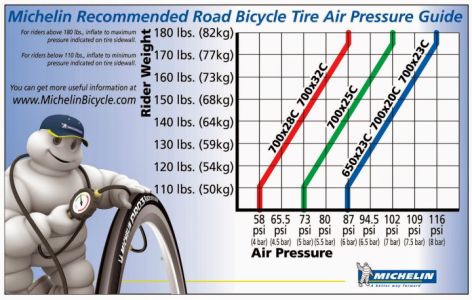
Bicycle tire manufacturer Michelin has published a very handy chart (I included it at the top of this page) on what tire pressure they recommend given the rider's weight and width of the tire. I would highly recommend using that chart as a starting point, then add or subtract a little pressure experimentally and see what feels best for you to determine your customized optimum tire pressure.

I would also like to add that many of us ride bikes that position the rider pretty upright (hybrids and relaxed-geometry road bikes), and for these bikes we need to use 10PSI less on the front tire because on an upright-riding bike more of our weight is supported by the back tire. Having less air pressure on the front tire also allows it to absorb shocks to give the rider better control, so you won't lose control and crash from the sudden shock of bouncing off a big bump. If it feels like you have to hold onto your handlebars with a death-grip to barely stay in control over the shocks and vibrations on your ride, you need to lower your front-tire pressure!

So there it is, my science-based recommendations on tire pressure in a nutshell: Use the Michelin guide chart at the top of this page as a starting point and try the pressure they recommend for your weight and tire width, then experimentally add or subtract a bit of pressure to find what feels good to you, and that's your custom tire pressure. 10PSI less on the front tire if you ride upright, decrease the front tire pressure until you have good control.

Hope this contributes to your safe riding and enjoyment! See you on a 5BBC ride.

Another Succesful Summer Streets Under 5BBC Belt

We have a reputation for friendly, fun, effective mechanical support! And we had more than 40 people sign up for our weekly as a result. 

Summer Streets is an annual tradition that let's pedestrians and cyclists share access to Park Avenue closed to automobile traffic for the first 3 Saturdays in August. 5BBC had a booth to raise awareness about the club and have some of our best mechanics offer their talents to support attendees needs that arise with their bikes or otherwise provide mechanical prowess. Great opportunity for some of our members new to bike mechanics to "understudy" and learn this or that aspect of bike mechanical knowledge. Fixing flats tended to predominate. Special shout out to the core team that manages this and are the stars of the show - they prefer to remain namless so I will encourage those of your who understudied this year to consider posting articles of your own about the experience and share it with the rest of the membership - how great it is to work with people who take pride and joy in helping others by sharing their mechanical prowess. It was fun to watch them work and please every single person who came by - left satisfied. Looking forward to next year too!


Pages